


{{ item.label }}
{{ item.value ? item.value : currencyFormat( item.amount ) }}
Subtotal
{{ currencyFormat( pricing_summary.total_amount ) }}
Checks whether a Mail Transfer Agent has a valid MX record.
Removes all emails containing invalid domains.
Sends untraceable emails to any address which can’t be validated using other methods.
Removes any duplicate email you may have in your records.
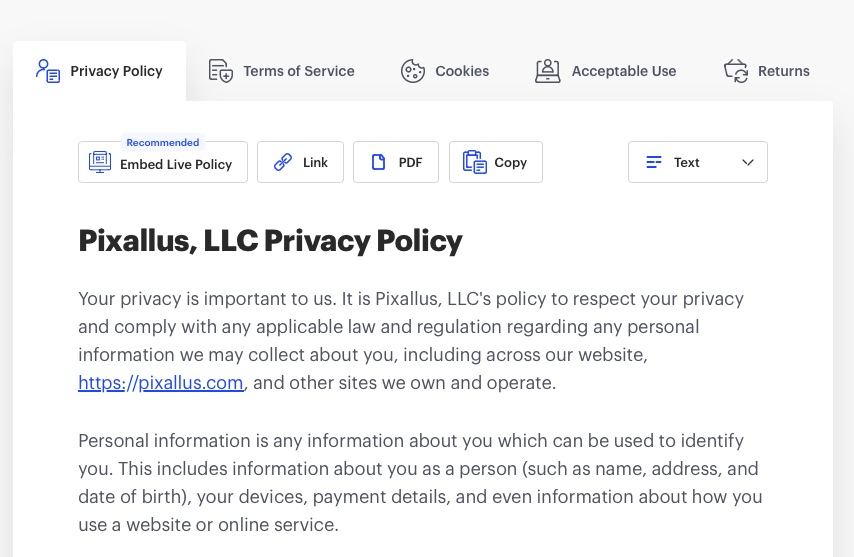
We will generate a personalized privacy policy for your business that is tailored to its unique characteristics.
In contrast to website terms, privacy policies may need to comply with privacy laws in the area of operation, especially when gathering personal information. It is advisable to have a data protection privacy policy, especially if collecting private data from users, such as payment details, address, phone number, and cookie data.
Furthermore, a privacy policy may be necessary for utilizing third-party APIs and services, such as Instagram, or for listing an app in a commercial marketplace like Google Play.
A privacy policy is important to comply with privacy laws and protect users’ personal information, especially when collecting sensitive data. It is necessary for various purposes, including legal requirements, third-party integrations, and commercial marketplaces. Every business should have a privacy policy in place due to specific privacy laws in most countries.
Strictly speaking, you don’t need a terms of service statement. It’s not required by law, but it’s generally wise to include one on your site to cover the expectations and agreements between you and your users. Some organisations may even request you make one available before you can enter into a relationship with them.
Most of the time, site owners and users behave in a fair and reasonable fashion, making your terms & conditions info redundant.
However, in unusual circumstances, such as those involving abuse, intellectual property theft or unlawful behaviour, having your terms & conditions stated explicitly can offer basic protections for you and your business by limiting your liability and clarifying your rights over the content you publish.
Websites sometimes collect personal information about their visitors for content publishing, analytics, promotional or contact purposes. It’s good practice to let your users know how you store and use their personal information. Whether you run a static site or a site powered by WordPress, Wix, Squarespace or any other content management system, you can use GetTerms’ Free Privacy Policy Generator to generate a generic privacy policy to share with your users, or opt for a Comprehensive Policy Pack tailored to your business.
If your website engages users in the European Economic Area, you may be obliged to publish a GDPR Compliant privacy policy. Of course, it takes more than just a privacy policy to be fully GDPR-compliant, but a clear and concise privacy policy outlining how and why you collect personal information is a good place to start.
Yes, you can customize the consent form and add it to your site using a plugin or script.
When you place an order for polices, it is valid for one (1) domain for lifetime usage. You are free to modify the content at any time.